
Source: cyprus-mail
Human ingenuity is the new currency, says Amazon senior vice president
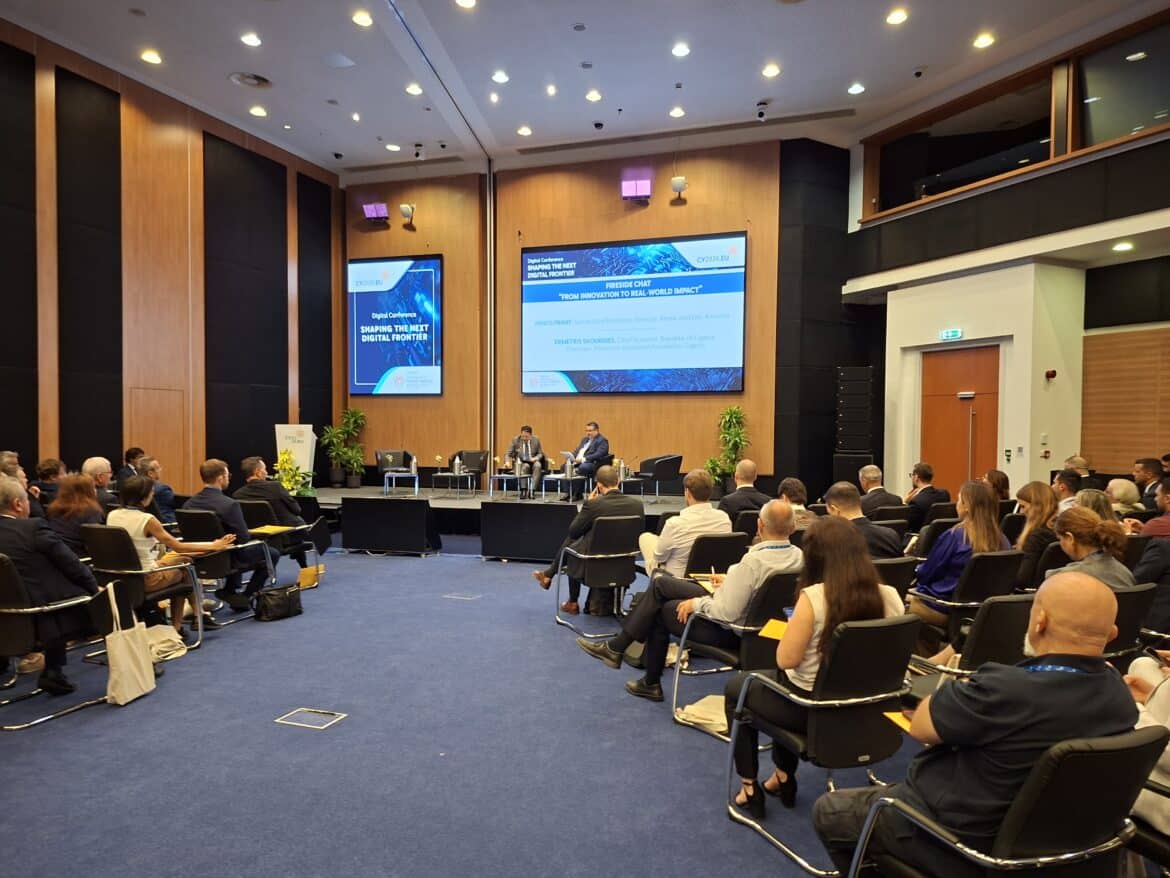
Europe and Cyprus must prioritise speed, connectivity and human ingenuity if they are to turn technological innovation into real-world impact in the age of artificial intelligence, according to Amazon executive Panos Panay.
Speaking on Wednesday during a fireside chat at the ‘Shaping the Next Digital Frontier’ conference in Nicosia, Panay, who is currently Amazon’s senior vice president for devices, Alexa and Leo, argued that successful technology ultimately depends on making people’s lives easier rather than simply introducing novelty.
The discussion, held as part of the Cyprus Presidency of the Council of the European Union, was moderated by Republic of Cyprus chief scientist and Research and Innovation Foundation chairman Demetris Skourides.
Panay, who oversees products including Alexa, Kindle, Fire TV, Ring cameras, Amazon Leo and other emerging technologies, said building products at scale while preserving a personal touch remained a difficult balancing act.
He explained that while novelty and innovation can inspire people and generate public excitement, truly meaningful products are rooted in basic human needs.
“Is this going to make my customer’s life easier? It’s that simple,” Panay said.
He argued that the fundamentals of learning, teaching, reading and writing have remained unchanged for centuries, adding that technologies that help people perform these activities more effectively become far more valuable.
According to Panay, a product’s long-term success often becomes apparent within the first three months after launch.
He explained that the first 30 days usually reveal the ingenuity of a product as users experiment with it.
By around 60 days, increasing usage indicates that the product is likely to become part of people’s lives, whereas declining engagement suggests that it may fail to gain traction.
Panay cautioned against assuming that consumers want one-size-fits-all products.
“We have a tendency to project our instinct but you need to be able to listen to the customer,” he said.
“If you serve their needs you can make their lives easier,” he added.
He warned that many innovations fail because they merely introduce change without improving people’s lives.
“People love to jump on the next invention and it often fails because it doesn’t make life better, just different,” Panay said.
Skourides raised the challenge of evaluating paradigm-shifting technologies that may require longer adoption cycles.
Responding, Panay said innovators must understand what signals they are listening for when usage remains low or products are still in their infancy.
He pointed to autonomous vehicles as an example, saying that despite technological advances, the underlying objective remains unchanged.
“It’s just that you are no longer driving, just get in and go,” Panay said.
He stressed that safety must always come first in autonomous systems, whether they involve cars, robots or other technologies.
“Getting somewhere but safely,” he said.
Panay recalled the development of Microsoft’s Surface devices, a project that was carried out under intense secrecy and therefore received little external feedback.
He explained that the central vision behind Surface was to improve productivity.
“The vision was helping the customer become more productive,” Panay said.
He acknowledged that launching the devices involved considerable uncertainty.
“Once you deliver it’s in the customer’s hands,” he said.
“You have to work from the customer backwards,” he explained.
Turning to innovation and speed, Panay said organisations should avoid becoming paralysed by perfectionism.
“You definitely want people the freedom to innovate and move fast,” he said.
“Speed beats perfection at the moment, which is hard to admit,” Panay added.
He suggested that governments could learn from startup ecosystems and become more agile in delivering solutions to citizens.
“The startup community should be emulated at the government level and innovate and get services or products to the customers or citizens quicker,” Panay said.
He argued that discussing technology in isolation is insufficient.
“You have to ship, you have to put products in people’s hands,” he said.
Panay revealed that the launch of Microsoft Surface represented one of the most difficult periods of his professional life.
“It was the toughest year in my career,” he said.
“It was a failure because the customers didn’t respond to the product at first,” Panay explained.
Although the product eventually succeeded, he said the experience demonstrated the importance of adaptation and speed.

The discussion later turned to artificial intelligence and whether the technology should replace humans or enhance their capabilities.
Panay made clear that he views AI primarily as a tool for human empowerment.
“It’s clearly a tool-based opportunity for people,” he said.
He argued that barriers preventing people from using AI should be removed and that ordinary users do not need to understand the underlying models.
“Let the scientists and policymakers work things out,” Panay said, in terms of safeguards and regulations.
He described the current moment as an unprecedented opportunity for creativity and innovation.
“The opportunity of human ingenuity to advance is like no time before,” he said.
Panay said his own teams had experienced dramatic gains in creativity through the use of AI tools.
“The new currency is human ingenuity,” he said. “Not using these tools is a missed opportunity.”
He stressed that trust and safeguards remain essential.
“As long as the trust and the guardrails are in place, it’s about enabling humans to accomplish more,” Panay said.
“There is fear and uncertainty but leaning into these tools can help people impact the world,” he added.
The conversation also addressed connectivity and resilience, with Skourides pointing to Cyprus’ position as an island and the importance of reliable, low-latency communications.
Panay said Amazon’s investment in Amazon Leo, the company’s low Earth orbit satellite constellation formerly known as Project Kuiper, is intended to address the lack of effective connectivity experienced by billions of people.
“All this capital expenditure is due to the need for great connectivity and connecting the world,” he said.
“There are billions of people in the world with ineffective connectivity,” Panay added.
He said the system is designed to deliver exceptional speed and low latency.
According to Panay, space-based internet could transform sectors such as maritime services while providing additional resilience.
“Internet from space, either as primary or backup, changes everything,” he said.
He emphasised that terrestrial networks would continue to play a major role, but satellite services would provide a crucial additional layer.
“Connectivity is not a luxury anymore, it’s critical,” Panay said.
Skourides also discussed Cyprus’ ambition to position itself as a digital hub and testing ground for innovation.
Asked what makes a country attractive in this regard, Panay highlighted flexibility, incentives and collaboration.
“If you want to be successful in this era, or Cyprus specifically, you have government, academia and industry,” he said.
“Those three need to work in tandem,” Panay stressed.

He argued that close cooperation between these sectors can provide speed advantages over larger and more cumbersome economies.
“Speed matters,” he said. “Especially in this AI frontier era.”
What is more, he praised Cyprus for its commitment and entrepreneurial spirit.
“In a country like Cyprus where the belief is strong and there is passion and you enable companies to thrive, there are few places more attractive right now,” Panay said.
Summarising the approach needed for success, he offered a simple formula. “Deploy, iterate, learn and scale,” Panay stated.
He acknowledged that iteration can occur quickly but scaling often takes considerably longer.
Asked about the strategies employed by hyperscale technology companies, Panay again stressed the importance of being receptive to customer feedback.
“You have to know your customer and be listening,” he said.
“When you find companies that listen to the customer then the business model comes eventually,” Panay added.
Looking ahead to the next five years, Panay rejected suggestions that the era of major technological breakthroughs is nearing its conclusion.
“Sometimes it’s easy to think that the frontier has passed,” he said. “It has not.”
He described the current period as the beginning of a profound transformation.
“We are at the beginning of a generational change, not the middle, not the end,” Panay said.
Reflecting on what excites him most, he pointed once again to the potential of human creativity.
“What excites me most from human ingenuity is what can come in five years’ time,” Panay concluded.