
Source: cyprus-mail
Live captions, sign-language tools and navigation support among solutions examined
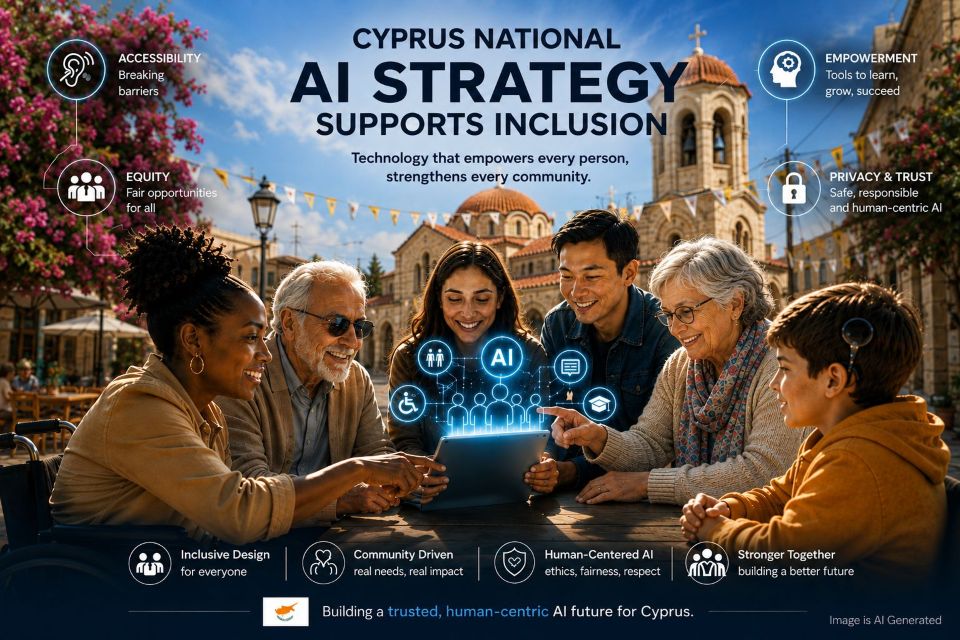
Cyprus’ National AI Strategy has examined how artificial intelligence could improve everyday life and make education, employment and public services more accessible to people with visual and hearing disabilities, according to an announcement from the Office of the Chief Scientist for Research, Innovation and Technology.
According to the announcement, the discussions took place during meetings with Pelagia Karpasiti, director of the Ayios Varnavas School for the Blind, and Kika Hadjikakou, director of the Georgios Markoudeaf school, as part of the consultation on the National AI Strategy 2032.
Together with staff from the two schools, the group considered the everyday difficulties faced by people with visual and hearing disabilities and identified areas in which AI could offer practical support.
At the centre of the discussions was the need for accessibility to be built into digital services and applications from the outset, rather than added later. The announcement said this would require the active involvement of people with disabilities and their representative organisations throughout the design process.
For people with visual impairments, the applications considered included AI-assisted access to documents and information, descriptions of images and surroundings, navigation support and the faster conversion of educational material into accessible formats.
In addition, the office said AI could support greater participation in the labour market through accessible meeting platforms, technologies that describe documents and data and voice-assistance tools.
However, it stressed that AI should complement human support, rather than replace it, particularly in areas such as orientation, mobility, rehabilitation, safety and important decision-making.
Turning to people with hearing disabilities, the discussions focused on how AI could help enable real-time communication between deaf and hearing people.
Among the tools examined were live subtitling in Greek and English, speech-to-sign-language technologies and applications capable of converting sign language into text or speech.
According to the announcement, such tools could prove particularly useful in services involving regular contact with citizens, including healthcare, social security, taxation and education.
Particular attention was also paid to Cyprus Sign Language, as solutions developed for other sign languages cannot automatically be considered suitable for use in Cyprus.
For this reason, the office said any effective system would require local data and should be co-designed with the School for the Deaf, organisations representing deaf people and the users themselves.
At the same time, it was noted that in more sensitive settings, such as healthcare services, legal proceedings and examinations, AI could improve accessibility without replacing certified or specialised interpreters when their presence is essential.
The group also emphasised the importance of protecting privacy and human dignity, particularly when technologies rely on cameras, mobile devices or real-time image processing. Such applications, it said, must operate transparently and remain under the effective control of the citizen.
Chief Scientist and president of the National Action Group on AI Demetris Skourides said that “the real measure of the success of an AI strategy is not only how advanced the technology becomes, but how substantially it improves people’s ability to participate in society and the economy”.
He added that “AI must serve people, people must maintain control and technological progress must broaden participation, not create new barriers”.
More broadly, the meetings with the two schools form part of the consultation process for the National AI Strategy 2032. During August, the group also met ministers, public administration officials, professional and business organisations and representatives from education, energy, trade, healthcare, tourism, shipping and taxation.
The strategy was prepared by the National Action Group on AI, which was established by a Council of Ministers decision, and the draft reflects Cyprus’ ambition to become a reliable AI hub in the Eastern Mediterranean and a European jurisdiction for services using artificial intelligence.