
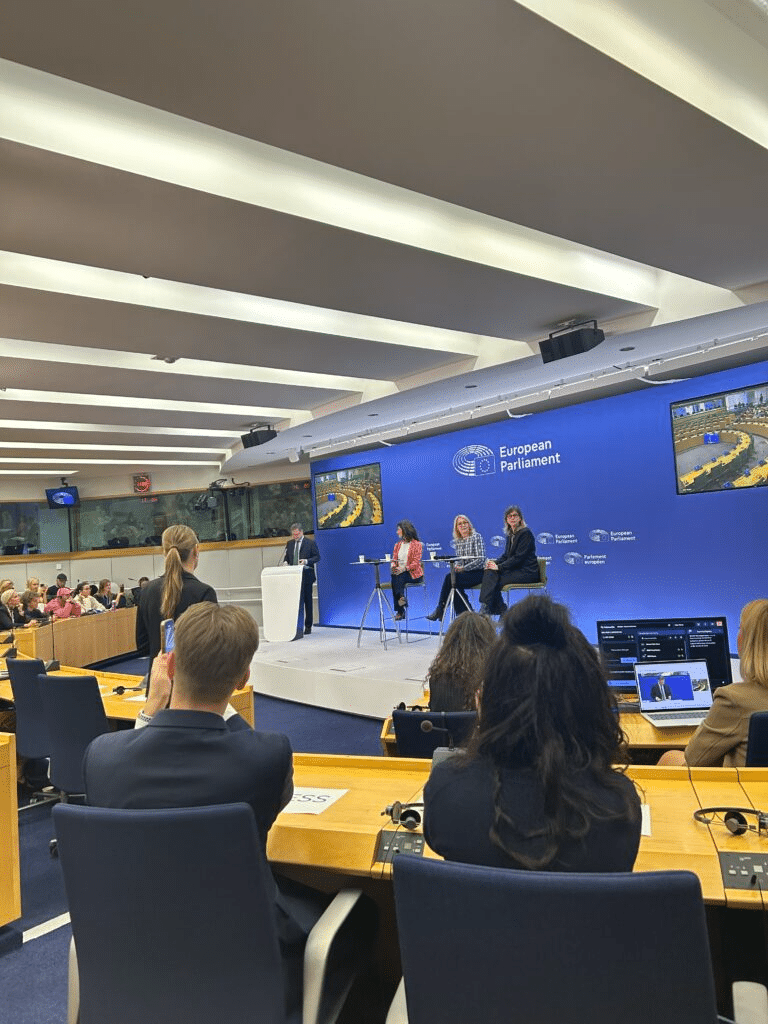
Source: in-cyprus.philenews.com
The European Parliament is opening a new chapter in the debate on protecting minors online, ahead of a plenary vote on related recommendations.
At a briefing for journalists and content creators in Brussels, Danish Vice-President of the European Parliament Christel Schaldemose and French lawyer Laure Boutron-Marmion highlighted the dark aspects of children’s digital lives and the regulatory steps Europe is attempting to take.
“Children must not be left alone in a world designed for profit”
Schaldemose, who has played a central role in the Digital Services Act (DSA), recalled that millions of children in Europe spend hours online every day, learning, playing and communicating, but often exposed to dangerous and illegal content. As she noted, major platforms and social networks have been designed primarily to keep users “hooked” to the screen through algorithms, infinite scroll and addictive design elements, not to protect the most vulnerable users—children. It is not, she stressed, just about what minors see, but how the systems themselves are structured.
Through the own-initiative report she took on in the Internal Market Committee, the European Parliament is proposing a tighter framework: a common European age limit for access to social networks with strong verification mechanisms, enhanced “safety by design” to limit the most addictive and manipulative features, and extension of the ban on targeted advertising to minors across more online services. The European Parliament Vice-President emphasises the need for a unified framework in the EU, rather than 27 different national approaches, and cites indicative guidelines of a minimum age of 13 and parental consent until 16. “We don’t want to keep children away from digital tools,” she noted, “but to ensure that when they are online, they are safe, which simply is not the case today.”
The dark face of platforms
If Schaldemose described the political and institutional dimension, Boutron-Marmion’s intervention gave the human and tragic depth of the problem. The French lawyer, with years of experience in child protection, spoke about the case of Marie, a teenager who took her own life before turning 16, whilst for months she was exposed to raw and uncensored self-harm content on TikTok. From this case the Algos Victima collective was born and the first class action against the platform in France was filed. As she describes, since then she has been receiving steady calls from parents talking about children addicted to screens, with insomnia from a very young age, with symptoms of depression and, increasingly often, with suicide attempts.
Boutron-Marmion insists that platforms can no longer hide behind the claim that they simply “host” third-party content. Without content, she says, platforms have no reason to exist, so content is an integral part of their business model and entails responsibility. She describes algorithms as a mechanism that “catches” the most vulnerable children—those already facing difficulties or in the fluid phase of adolescence—and leads them into a vicious circle of macabre content from which they struggle to escape. She stresses that legally, companies must be treated as accountable when harm results from their practices, as happens with any other commercial activity.
Both speakers agree that the era of the “Wild West” on the internet must gradually come to an end, with Europe adopting a more coherent and strict framework for protecting minors. The discussion highlighted the need for stronger oversight of major platforms, for substantial restrictions on addictive app features, for more effective protection against harmful content, and for a unified European regulatory framework that leaves no room for failures.
The resolution to be put to the European Parliament plenary is expected to shape the body’s official position, whilst the next major institutional move is set for 2026, with the proposal for a Digital Fairness Act. The challenge, as emerges from the Brussels discussion, is this: to prove that Europe can make the digital environment fairer and safer for its most exposed users, especially children and teenagers.
Read more: