
Source: cyprus-mail
Cyprus firms urged to build AI foundations before adopting new tools
Cypriot businesses need to organise their data, establish clear rules and train employees before adopting artificial intelligence (AI), according to Kyriaki Parmakki, co-founder and chief executive of Limassol-based solutions studio essere.ai, who hosted the first ClickUp event in Cyprus earlier this month.
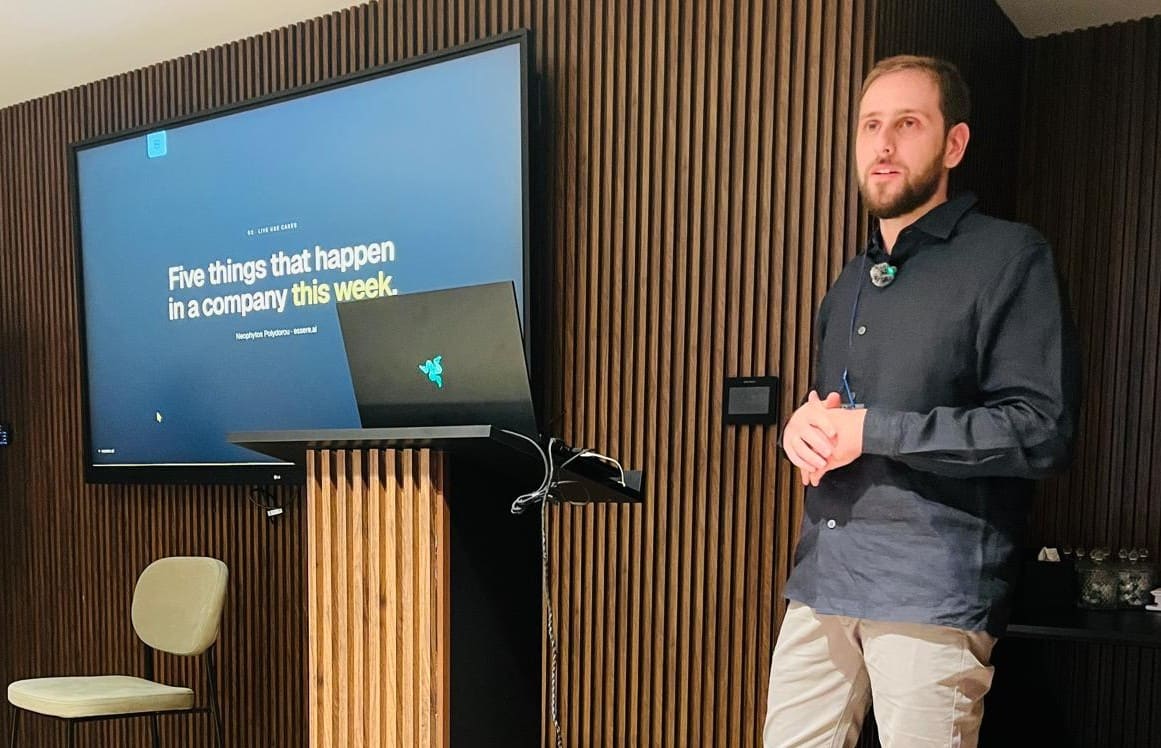
The event, held on October 8, brought together business owners, directors and technology specialists to explore how companies can integrate AI into their operations, with demonstrations of practical applications and discussions on the foundations needed to make the technology effective.
ClickUp, an American software company valued at $4 billion and known for its project management, task management and AI capabilities, held its first event on the island in partnership with essere.ai, which is ClickUp’s official and certified partner in Cyprus and the only partner it works with directly on the island.
In an interview with the Cyprus Mail, Parmakki said that the event highlighted a growing gap between individuals’ willingness to use AI and the extent to which businesses have integrated it into their operations.
“In 2025, 44 per cent of people in Cyprus used generative AI, against an EU average of 33 per cent, while only 9 per cent of Cypriot companies used AI, less than half the EU rate of 20 per cent,” she said.
“People in Cyprus are ahead of their companies.”
She added that the event’s attendance and the questions raised by participants suggested that businesses were increasingly interested in practical implementation rather than simply debating whether to adopt the technology.
“Appetite is not the problem. The room was full on a Thursday evening, with owners and directors, and the questions were about how, not whether,” Parmakki said.
“ClickUp choosing Cyprus for its first event here means international platforms now see this market too.”
The event featured a presentation by ClickUp guest speaker Mary Bornaghi, who outlined the platform’s approach to bringing work management and AI together, while Parmakki presented the fundamentals businesses need before introducing AI.
Neophytos Polydorou, senior AI engineer at essere.ai, demonstrated 5 live use cases using real systems and demonstration data, while representatives of 2 companies discussed how moving their work into ClickUp had changed their operations.
The evening concluded with an AI-readiness assessment that participants could complete on their phones, followed by networking.
A central theme was that businesses should focus on their operational foundations before investing in AI tools, with Parmakki arguing that the technology’s effectiveness depends on the quality and accessibility of the information it can use.
“Everything a company does is data. A call, an invoice, a message, an approval. AI can only work with what it can read, so the first question is never which tool, it is where the data lives,” she said.
She described 4 stages of business development according to how information is managed, ranging from data held in employees’ heads to information stored in separate files, then organised in systems, and finally supported by AI intelligence.
“Moving up one step always means the same thing, organising the data, and only then does AI have something reliable to work with,” Parmakki said.
Skipping this groundwork can result in AI producing generic responses or confidently delivering incorrect information, while employees may turn to personal AI accounts to handle company information because their employers have not provided suitable systems.
Businesses may also struggle to translate individual productivity gains into measurable commercial results.
Parmakki cited McKinsey research involving 1,700 executives, saying 80 per cent reported that AI made them personally more productive, while only 37 per cent of companies saw the benefits reflected in their results.
“The gap between those two numbers is the foundations,” she said.
The event also examined the growing use of AI by employees, including the security implications when individuals adopt tools without company oversight.
According to figures presented during the event, the proportion of employees regularly using AI on their work computers had increased from 15 per cent to 45 per cent in 1 year, while 2 thirds of those users signed in through personal rather than company accounts.
“The question is not whether your people use AI. It is whether the company knows,” the event’s presentation stated.
Parmakki said the most immediate returns tended to come from processes involving large volumes of unstructured information, including telephone calls, emails, invoices and documents.
Examples included answering calls in the caller’s language, recording the details and making bookings while other employees continued their work, as well as reading, checking and filing supplier invoices without requiring someone to open each email.
Other applications could prepare short morning briefings identifying tasks at risk of missing deadlines and suggesting how work could be reassigned.
“These are not pilots. Each one removes a chore that repeats every week, and a person can check the result in seconds,” she said.
However, she stressed that businesses must establish clear boundaries for AI agents before allowing them to operate.
“Before an agent goes live we write three things down, what it may read, what it may do on its own, and where a person decides,” Parmakki continued.
“Draft yes, send no. Suggest yes, pay no. No decisions about people or payments without a person.”
She added that every action should be logged and the records reviewed weekly, allowing companies to monitor whether AI systems are operating within their permitted limits.
The live demonstrations illustrated how these principles could work in practice, including a support call recognised and handled by an AI agent called Ciao, which helped the caller and made a booking.
Another demonstration showed an 8am briefing identifying a task at risk and proposing that it be reassigned, while an AI agent prepared month-end billing for approval by a person.
Other examples included filing a supplier invoice without anyone having to read the inbox and conducting a weekly security review in which an agent checked every action against established rules, including access it had been denied.
The event also addressed the distinction between developing bespoke software and configuring existing platforms, with the presentation arguing that although building software has become more accessible, maintaining it still involves logins, permissions, mobile applications, backups, security, updates and support.

The departure of the person who originally built a system can also create difficulties for the business.
The recommendation was to build technology where it creates a genuine competitive advantage and configure existing tools for other requirements.
Regulatory compliance was another key theme, particularly the European Union’s AI Act and the responsibilities it places on businesses.
“The EU AI Act already asks two things of every company, train your people on AI, and tell customers when they are talking to a machine,” Parmakki said.
The event presentation stressed that businesses should provide AI training and retain evidence of that training, while making clear to people when they are interacting with AI.
It also highlighted the heavier requirements for AI systems making decisions about people and money, which Parmakki said were due to arrive in December 2027.
Beyond regulation, she argued that a lack of expertise and uncertainty about legal requirements and data protection were more significant obstacles to adoption than the price of the technology.
“The gap is not technology, and it is not money. It is knowledge, and fear,” she said.
“Most companies do not know where to start and do not know where this is going, so they wait.”
She referred to Eurostat findings on businesses that had considered AI but decided against adopting it, saying the most frequently cited reason in Cyprus and across the EU was a lack of relevant expertise, followed by legal uncertainty and data protection concerns, while cost ranked considerably lower.
Parmakki said essere.ai aimed to bridge that gap through education before technology, helping business owners understand what AI could do within their own operations, where it was appropriate and what needed to be in place first.
For companies seeking to move beyond experimentation, she identified 3 priorities, beginning with establishing a reliable operational system that the business owns.
This should provide a single source of information for clients, tasks, documents and figures, rather than relying on employees’ memories, inboxes and spreadsheets.
The second priority is to establish written rules governing what AI can access, which actions it can perform independently and when human approval is required, with every action logged and a designated employee responsible for oversight.
The third is to train employees, move them away from personal accounts towards company accounts and select a single recurring process in which AI can be introduced and tested.
“Pick one process that repeats every week, put AI inside it, run it for four weeks with a clear yes or no at the end, and only then take the next one,” she said.
“That is the difference between experimenting and integrating.”
Parmakki argued that businesses did not need to begin with an extensive strategy document or bespoke software, but rather with sound preparation and a disciplined approach to implementation.
“None of it needs a strategy document or custom software. It needs the groundwork done properly, and the discipline to start small,” she said.
The event also presented Gartner’s expectation that 60 per cent of AI projects lacking AI-ready data would be abandoned, reinforcing the importance of preparing business information before introducing additional tools.
The broader message was that AI adoption should be treated as an operational change rather than simply a technology purchase, with the potential benefits depending on how well companies organise their work, protect their information and equip employees to use the technology effectively.