
Source: cyprus-mail
Cyprus has spent years talking about becoming an innovation economy.
If the country wants to make that transition, research and innovation can no longer be treated as a secondary area of economic policy.
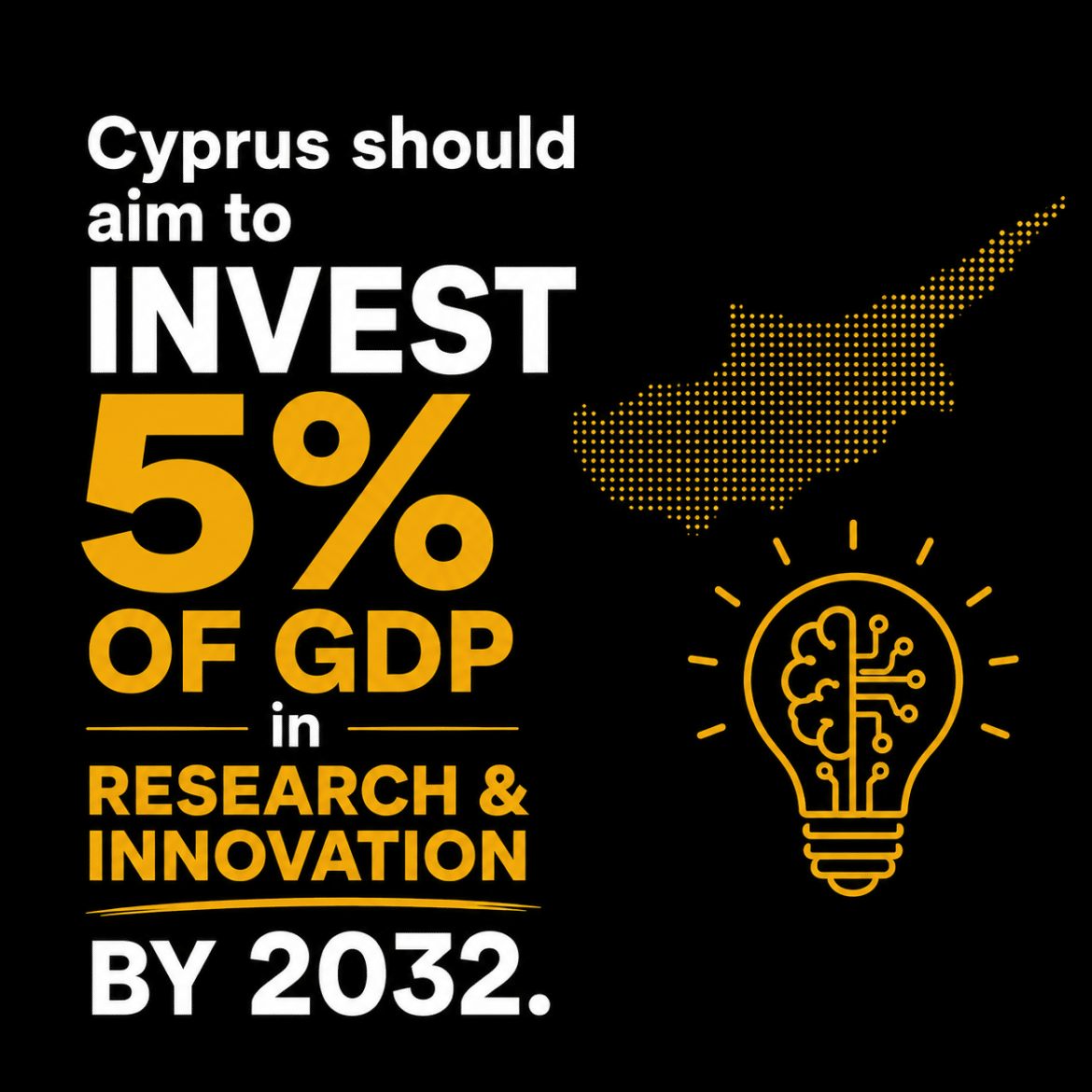
The government should set an ambitious national objective: mobilise public and private investment in research and development to reach at least 5 per cent of GDP by 2032.
It would be an aggressive target.
It would also force Cyprus to rethink how it wants its economy to grow over the next decade. The starting point shows the scale of the challenge.
According to the Statistical Service, Cyprus spent €213.6 million on research and development in 2023, equivalent to just 0.68 per cent of GDP. The EU average was 2.26 per cent. Provisional comparative data put Cyprus even lower, at around 0.65 per cent in 2024. By comparison, Germany was at 3.13 per cent, Austria at 3.26 per cent and Belgium at 3.36 per cent. Moving towards 5 per cent would therefore not be a marginal increase.
It would require a fundamental change in economic policy. But this is precisely the discussion Cyprus needs to have. Research spending is economic policy. The case for investing in research is not simply about supporting universities or scientists.
It is about productivity.
Countries cannot sustainably increase GDP simply by adding more workers, building more properties or attracting more tourists. Over the long term, an economy also needs to become better at producing more value from the people, capital and resources it already has. Innovation is one of the mechanisms that makes this possible.
Research creates knowledge. Businesses can turn that knowledge into products, technologies and services. New companies can emerge around intellectual property.
Existing companies can become more productive. Universities can generate spin-offs. International companies can establish research centres. Highly skilled jobs can replace part of the economy’s dependence on lower-value activities.
The OECD has found a clear relationship between R&D investment and productivity. Earlier OECD research estimated that a 1 per cent increase in business R&D was associated with a 0.13 per cent increase in productivity growth, while increases in public and foreign R&D also produced positive productivity effects. More recent OECD analysis reinforces the argument. It concludes that additional public expenditure on R&D can attract private investment, stimulate innovation and improve productivity and living standards over the longer term.
Its modelling also suggests that increases in basic research expenditure can generate measurable labour-productivity gains within several years. This matters because productivity ultimately affects GDP.
If a Cypriot company can generate twice as much value using the same workforce because it has developed better technology, processes or intellectual property, the economy becomes more productive. Multiply that effect across hundreds or thousands of companies and you begin to change the structure of the economy itself.
Five per cent cannot come from government alone
A target of 5 per cent should not mean that the government simply increases public spending until research expenditure reaches 5 per cent of GDP. That would be neither realistic nor desirable.
The objective should be to mobilise investment across the entire economy.
Government should provide long-term research funding and incentives. Universities should increase research and commercialisation activity. Large companies should establish R&D operations in Cyprus. Local businesses should receive stronger incentives to invest in research. Startups should have better access to capital and research infrastructure. Foreign technology companies should be encouraged to establish research centres and laboratories on the island.
The weakness of private investment is particularly important.
The European Commission reported in 2025 that public R&D intensity in Cyprus stood at only 0.29 per cent of GDP in 2023, compared with an EU average of 0.72 per cent. Business R&D stood at 0.28 per cent, around five times below the EU average.
The Commission also identified weak commercialisation and fragmented links between universities, startups, government and the financial sector.
This is where policy needs to change.
Cyprus needs to move beyond distributing millions through individual programmes and begin thinking about how to mobilise billions of euros of public and private capital over several years.
That could include stronger R&D tax incentives, co-investment mechanisms, research infrastructure, competitive grants, incentives for multinational R&D centres, university-industry programmes, venture capital and, critically, a functioning framework that allows researchers to commercialise their work and create spin-offs.
Cyprus already has one important advantage
There is another reason why Cyprus should consider such an ambitious strategy.
Its people.
Cyprus has one of Europe’s most highly educated young populations. In 2024, 60.1 per cent of people aged 25 to 34 had completed tertiary education. The EU average was 44.1 per cent. Cyprus was behind only Ireland and Luxembourg among EU countries.
There is also considerable educational depth within the technology workforce. Eurostat reported that 96.4 per cent of employed people in Cyprus with an ICT education had tertiary education in 2025, one of the highest proportions in the EU. But having graduates is not enough.
The European Commission’s Education and Training Monitor points to an important contradiction. Cyprus has very high tertiary attainment but one of the EU’s lowest shares of students enrolled in STEM subjects.
It also reports that 30 per cent of workers with higher-education qualifications were employed in occupations that did not require that level of qualification in 2023. This should be seen as both a warning and an opportunity.
Cyprus has invested heavily in educating its population.
The next challenge is creating an economy capable of using that human capital. A stronger research and innovation sector can help.
Instead of asking why talented Cypriot researchers, engineers, scientists and technology professionals leave for London, Berlin, Amsterdam or the United States, Cyprus should ask what would be required for them to build their careers here.
Research centres need researchers. Deep-tech startups need engineers. Biotechnology companies need scientists. AI companies need computer scientists and data specialists. Universities need research funding. Technology companies need highly skilled employees.
Human capital and research investment reinforce each other. Without investment, highly educated people leave or work below their potential. Without skilled people, research investment cannot produce its full economic return. Cyprus has an opportunity to connect the two.

The economic impact could extend far beyond research
Increasing research investment would not create economic activity only inside universities and laboratories. It could affect the wider economy.
More R&D can create demand for engineers, researchers, software developers, lawyers, accountants, intellectual-property specialists, designers and specialised consultants.
Successful research can generate patents and intellectual property. Universities can create spin-offs. Startups can grow around technologies developed in Cyprus. International companies can establish research operations on the island.
Cypriot businesses can improve their productivity and become more competitive internationally. And importantly for a small economy, more companies can build products and services that can be exported without being constrained by the size of the domestic market.
That is how research investment can ultimately contribute to GDP growth.
Not because every euro spent on research automatically generates economic growth, but because successful research increases the capacity of an economy to create knowledge, technology, companies, exports and productivity.
The distinction is important.
Simply spending 5 per cent of GDP will not guarantee success. The money has to produce outcomes.
Cyprus needs a measurable national mission
A 5 per cent target therefore needs to come with accountability.
The government should define how much investment will come from the state, businesses, universities, European programmes and international investors. It should identify priority research areas where Cyprus can realistically develop international advantages.
It should measure patents, university spin-offs, research commercialisation, private R&D investment, high-value employment, technology exports, productivity growth and foreign R&D investment. And it should publish the results.
The objective should not be to become a country that simply spends more money on research.
The objective should be to become a country that turns research into economic value.
Cyprus already has universities, researchers, startups, technology companies and one of Europe’s most highly educated young populations. What it lacks is the scale of investment required to connect these assets into a significantly larger economic engine.
Reaching 5 per cent of GDP by 2032 would be extremely difficult. That is precisely why setting such a target could change the conversation. If Cyprus wants research and innovation to become a national catalyst for economic development, millions will no longer be enough.
The country needs to start thinking in billions.