
Source: in-cyprus.philenews.com
“The group’s going for coffee in a bit. I’d like you to come along,” you tell your friend. “I’d love to as well, but that’s impossible—you know I died two years ago.” This conversation doesn’t come from the future, nor is it a scene from a science fiction film. It’s already happening, thanks to Artificial Intelligence, which creates digital avatars of people who have died and is capable to a great extent of altering the finality of death.
Artificial Intelligence, Katarzyna Nowacjuk, a researcher at the Leverhulme Centre for the Future of Intelligence at the University of Cambridge, told Phileleftheros in an interview, is disrupting our relationship with our dead by essentially creating digital immortality.
Whilst for centuries this was one-way communication, now the illusion of a two-way relationship is being created—one where nothing is lost and everything lives forever.
Of course, the implications are expected to be enormous. “This is a massive social change, because now suddenly death doesn’t necessarily mean the end of relationships. It’s like saying ‘see you out there somewhere’ rather than saying goodbye.
So the potential implications—cultural, social, political, even ecological—are huge,” she said, emphasising that artificial intelligence will enable the creation of a new relationship with our dead, which will depend on new business, ethical, and legal decisions.
This is why legislative regulation of the issue is particularly important, as behind digital immortality lie companies trying to make money by capitalising on our grief and sadness, who won’t hesitate to exploit us. For some people, Katarzyna Nowacjuk noted, digital immortality is a good solution; for others, it isn’t.
Loss and death are part of life, and we need to be able to manage them. “Education is important, so that everyone can make the right decision. We all need to understand how this technology works, what the risks are, and what suits each of us,” she stressed.
What exactly is the Leverhulme Centre for the Future of Intelligence at the University of Cambridge?
At the Leverhulme Centre, we work to understand, design, and implement artificial intelligence in various areas of our lives in a way that’s safe for us. Personally, I specialise in digital death, or digital immortality.
That is, I’m trying to understand how the enormous quantity of data we produce daily can be used after our biological death. I’m also trying to understand how artificial intelligence is changing the way we perceive, experience, and prepare for death and grief.
How does digital immortality differ from traditional practices of remembering someone who has died?
Well, there are many similarities, but at the same time there’s one big difference. For centuries, our communication with the dead was one-way. We visited cemeteries, had various rituals, looked at and spoke to their photographs. It was one-way communication.
But for the first time in history, we’ve created a situation where we can have two-way communication—when we ask questions and our deceased loved ones answer them, when they speak to us. However, to be precise, I should emphasise that it’s just an illusion of two-way communication, because obviously we’re not speaking with the person who has died but with an avatar.
It’s not the deceased. It’s simply a representation of them, created from their personal data and curated by artificial intelligence. And behind this conversation, there’s a very complex calculation, and yes, it’s an entity guided by artificial intelligence. It’s an illusion and not reality.
What’s the process? What does someone need to do to create an avatar of a deceased loved one?
The process is simple. There are commercial companies that do this, and the more personal data someone provides them, the more accurate and sophisticated this representation becomes.
The first step is to choose the company and then give them as much data as possible. Then, artificial intelligence collects this data and interprets it, connecting different pieces of information so that it’s ready to answer questions and predict what would be the most likely answer the deceased person would have given.
So that’s the “magic” behind it: artificial intelligence tries to predict what a person would say in a particular context.
Is this legal? I mean, can someone give a company the personal data of someone who’s no longer alive?
Unfortunately, yes. As technology and the legal framework stand today, such a thing is legal. It’s sad, but at the moment there isn’t a legal framework that would make us feel secure. So if someone wants to create an avatar after my death, it’s legally and technically possible.
This is something that people like me who work in this field are trying to implement and promote: that there should be explicit consent from people before their avatar is created, so that those who will give the data are fully informed about how it will be used. We’re not protected.
And I should note that in the European Union, we have the GDPR regulation, which really helps us a lot to protect our personal data, but this applies whilst we’re alive and doesn’t apply when we’re dead.
The issue is creating an avatar in the image and likeness of the deceased. But what happens when we want exactly the opposite? For example, someone with an abusive father creating a loving avatar of him that asks for forgiveness.
This is a great issue and there’s a lot of discussion around it. To what extent are the creators of these technologies allowed to study and change someone’s life?
It’s a very important ethical issue—whether we should change someone’s biography or whether it’s permissible to correct people’s relationships posthumously.
We need to answer who can decide what will happen, which events will be preserved and which won’t. And the question isn’t only philosophical or ethical, but also practical, as it needs to be decided legally what’s allowed and what isn’t.
For thousands of years, societies functioned with the fact that people are born, live, and die. Now this is changing in a way. What are the potential dangers of living forever, even in digital form?
This is a massive social change, because now suddenly death doesn’t necessarily mean the end of relationships. It’s like saying “see you out there somewhere” rather than saying goodbye. So the potential implications—cultural, social, political, even ecological—are huge.
For example, psychologically, at the moment we don’t understand how these technologies change the way we experience grief and how we process death.
Many psychologists worry that this could have genuinely harmful consequences and that we could develop a form of emotional dependency, because these technologies can be addictive. They claim, in fact, that it’s as addictive as drugs and that some people will struggle to abandon the avatars of their deceased loved ones and to live without them.
That’s why several experts suggest that this technology should be used as a medical device under the supervision of psychologists, psychiatrists, in very carefully organised environments.
Another danger lies in the fact that digital immortality is currently dominated by commercial companies, and it’s they who shape the way these products are designed. Considering that their main motive is profit, this is particularly worrying.
There’s a huge risk that commercial companies will use various, perhaps unethical, strategies to increase their profit and data exploitation.
We can imagine a situation where you’re talking with your deceased loved one, your grandmother, for example, with whom you had a very beautiful relationship, and she suggests you buy a particular product that, of course, also suits your needs.
There’s an environmental cost as well, isn’t there?
Exactly, yes. When we think about one posthumous avatar, we don’t see a problem. But when we think about millions of avatars, we can start discussing the environmental cost of producing these technologies, because it’s simply a myth that digital immortality is immaterial.
In reality, it requires many resources for data centres and servers to function, and all of this needs water, land, electricity, and all that. The question is whether we should invest in the memory of previous generations or whether we should think about future generations as well.
What’s your advice for someone who has lost a loved one? What should they do to manage their loss?
Death is a very personal journey and there isn’t some standardised path for someone to follow. The first thing they need to do is listen to themselves, to their needs and fears. There aren’t specific stages they need to go through or points to reach for it to be a healthy process.
At some point, they might consider the possibility of using digital immortality technology, but this is a very personal decision. What I would suggest is that, as a first step, they try to understand how it works and the risks that exist. Because digital immortality certainly isn’t a universal solution to loss.
For one person it might work and bring comfort and be a very beautiful experience. But at the same time, the same technology could be catastrophic for someone else. That’s why my advice is that we need to be careful. Very careful.
“Death is a skill”
I get the impression that we’re moving towards a hybrid zombie society, where the dead and the living will coexist in digital applications. Could this disrupt one’s perception of life and death to the point where we don’t care whether someone dies or not, since we’ll continue speaking to them?
It’s a very important question; however, it’s genuinely difficult to predict how we’ll react to these technologies. I often say that we’re in the middle of a techno-cultural experiment and we genuinely don’t understand the consequences of introducing these technologies on a large scale into society across the world.
I’m not certain whether we’re ready to accept or embrace these technologies to such an extent that death has no meaning for us. I don’t think we’re already at the point where it makes no difference whether the person is biologically alive or in a virtual space.
Is digital immortality, in a way, a failure to face loss and grief?
This is my concern as well—that we struggle so much to accept loss and to say goodbye to things, to accept the natural cycle of life, that we’re creating the illusion that we don’t need to lose anything in our lives. And I’m not sure whether this approach is entirely healthy.
I believe we need to try to train ourselves to be ready to lose things, to be ready for loss. Perhaps these technologies can support this process.
I recently participated in a relevant discussion with experts from India and China. And we asked them how we can use Artificial Intelligence in this context of end of life in a way that’s beneficial to us.
They suggest that perhaps Artificial Intelligence could be used in a way that helps us face the idea of death, helps us understand that we’re mortal, because at the end of the day, this doesn’t change anyway. We could perhaps apply it in a way that educates us to think about death, how to face it, and how to prepare for this very particular moment.
One of the Indian experts told us that “death is a skill”. Perhaps this is true, and therefore we need to learn how to acquire it. The first step is to discuss it, to be more open and sensitive, to express our wishes, fears, and hopes regarding death, and then technology has a role. So the first thing is dialogue, discussion.
I’m trying as we speak to work out whether you’re for or against digital immortality, and I confess it’s difficult to tell.
I believe there’s potential for positive outcomes, but we need to work very hard to achieve it. And at the moment, we’re not on the right path towards this bright future.
There are many things that need to be corrected or changed in order to reduce the potential dangers and negative impacts. We need to achieve a better legal framework.
And we also need to try to break the monopoly that commercial companies have in shaping these technologies. This is a very sensitive issue.
How feasible is something like that, considering the power that technology companies have?
I believe—yes, I remain optimistic. However, it’s very early to say; we’re at the beginning of this journey. Nevertheless, my colleagues who work in this field, who have legal backgrounds, are lobbying or working towards certain ideas that could help us reshape this landscape.
Researcher Edina Harbinja proposed the idea of “posthumous personal data”, something like the GDPR we mentioned earlier, but for the dead. The privacy of the deceased is important.
What happens if someone doesn’t want to become an avatar after they die? How can we prevent this and protect our personal data even if we’re not alive? And what happens to someone’s dignity when they’re not alive? What if they don’t wish to live in digital form?
I believe we need regulations that will be inclusive and will protect the interests and wishes of both sides. That is, those who want to remain “alive” and those who don’t want to be present for years.
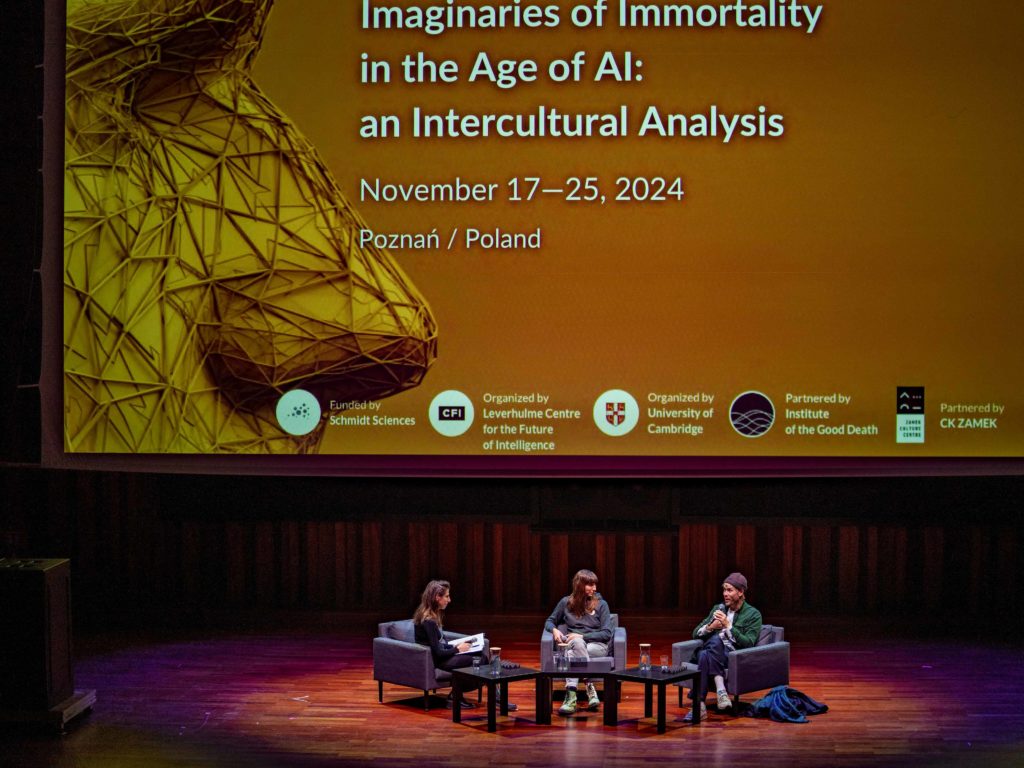
(images source: Tomasz Siuda)