
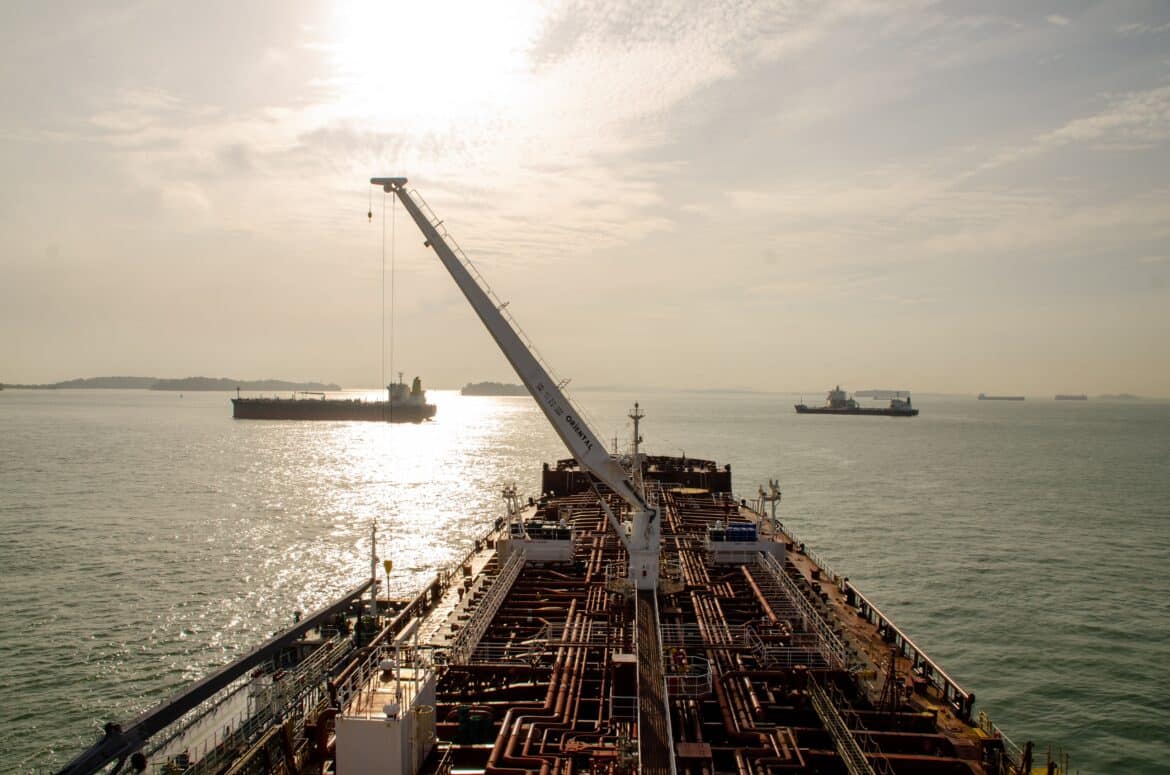
Source: cyprus-mail.com
Shipping companies in the Eastern Mediterranean are raising their climate ambitions faster than their ability to implement them, with financial pressures, skills shortages and limited operational capacity emerging as increasingly significant obstacles to decarbonisation.
The findings come from the second wave of the METAVASEA survey, released by the Hellenic Marine Environment Protection Association (HELMEPA), which gathered 1,182 responses from seafarers, shipping companies, port administrations, service providers, suppliers, civil society and port cities.
Data were collected between December 2024 and November 2025, bringing the combined number of responses from the first two survey waves to 2,080.
The results show that companies are increasingly aligning their strategies with international climate targets, but implementation is proving considerably harder.
The share of shipping company representatives saying their organisation had a net-zero strategy aligned with the International Maritime Organisation’s 2050 target rose to 22 per cent from 14 per cent in the first survey wave. A further 9 per cent said their company had adopted a more ambitious strategy.
At the same time, 59 per cent said their company now had a Sustainability Manager or dedicated sustainability department, compared with 49 per cent previously, while the proportion monitoring Scope 1 emissions increased to 78 per cent from 73 per cent.
However, the barriers companies reported moved sharply in the opposite direction.
Financial constraints were cited by 59 per cent, compared with 46 per cent previously, while limited implementation capacity rose to 50 per cent from 29 per cent. The proportion reporting insufficient awareness of available solutions almost doubled to 50 per cent from 27 per cent.
The gap is particularly relevant as shipping faces tighter international and European rules. The IMO’s greenhouse gas strategy targets net-zero greenhouse gas emissions from international shipping by or around 2050, alongside indicative reductions of at least 20 per cent, while striving for 30 per cent, by 2030 compared with 2008 levels.
European operators are also already working under the EU Emissions Trading System, which has covered maritime transport since January 2024. The proportion of emissions requiring allowances is being phased upwards, reaching 100 per cent from 2026, when methane and nitrous oxide also enter the system alongside carbon dioxide.
Meanwhile, the FuelEU Maritime regulation, which has applied fully since January 2025, is intended to accelerate the uptake of renewable and low-carbon fuels and clean-energy technologies.
Against that backdrop, the METAVASEA findings show that seafarers are becoming more familiar with the regulatory environment.
Awareness of the EU ETS rose to 47 per cent from 34 per cent, while familiarity with FuelEU increased to 45 per cent from 33 per cent. Understanding of the IMO greenhouse gas strategy climbed to 56 per cent from 45 per cent, passing the halfway mark for the first time, while familiarity with EU monitoring, reporting and verification rules rose to 41 per cent from 30 per cent.
Training, however, continues to lag. Only 45 per cent of seafarers said they had received decarbonisation-related training over the previous two years, although this was an improvement from 36 per cent in the first wave. That still leaves 55 per cent without relevant training.
Among those who had received training, alternative fuels dominated the content, cited by 66 per cent, followed by EU ETS at 36 per cent, monitoring and verification at 25 per cent and FuelEU at 24 per cent.
Safety pressures remain another significant concern.
Crew fatigue was identified by 69 per cent of seafarers as their leading safety concern, almost unchanged from 70 per cent previously. Inadequate training followed at 25 per cent, with communication problems and handling unfamiliar equipment both at 24 per cent, while 22 per cent pointed to the use of new alternative fuels.
Cybersecurity was cited as a safety concern by 11 per cent, up from 8 per cent, even as digital technologies become increasingly embedded in vessel operations.
Some 70 per cent of shipping company respondents said they were already using performance-monitoring tools, while 79 per cent of seafarers regarded digital transition and basic digital awareness training as very or extremely necessary.
Yet just 17 per cent of companies identified digital and cybersecurity skills as a core seafarer competency, compared with 16 per cent of seafarers and 11 per cent of service providers.
The survey also points to changing preferences around alternative fuels.
Biofuels remain the leading transitional option, with 59 per cent of companies either already using them or planning to do so.
By contrast, LNG fell sharply to 9 per cent from 25 per cent, methanol declined to 11 per cent from 19 per cent, and ammonia dropped to 7 per cent from 14 per cent.
Asked about longer-term potential, 46 per cent favoured biofuels, followed by green hydrogen at 20 per cent, green methanol at 17 per cent and green ammonia at 15 per cent.
The findings also highlight weak preparedness at ports, although HELMEPA cautioned that the available sample is small.
Across the combined first and second survey waves, covering 11 ports, 73 per cent reported having no low-carbon fuel infrastructure, 45 per cent lacked ship-emissions monitoring capabilities and 36 per cent had no planned decarbonisation measures.
For Cyprus, the project has a direct connection through the Cyprus Marine Environment Protection Association (CYMEPA), which is a core METAVASEA partner.
CYMEPA’s work includes training and awareness programmes for maritime professionals and young people, developing tools for skills in alternative fuels, digital transformation and maritime safety, as well as gathering feedback from the Cypriot shipping community and the wider public.
The wider METAVASEA programme aims to train and upskill 1,500 seafarers, shipping professionals and port workers in areas including new fuels, digital awareness, sustainability and soft skills, while examining how ready Eastern Mediterranean shipping and coastal communities are for the transition.
Public understanding remains another challenge. Some 55 per cent of civil-society respondents described shipping’s contribution to global greenhouse gas emissions as very or extremely significant, even though the sector represents roughly 3 per cent of global CO2 emissions.
Meanwhile, 41 per cent said they were unaware of any greenhouse gas reduction initiatives in maritime transport and 35 per cent were unsure which alternative fuel offered the strongest future potential.
The findings were presented at the ECONSHIP conference in Chios and will also feed into the “People-Centred Maritime Decarbonization: From East Mediterranean Findings to Global Pathways” workshop at the World Maritime University in Malmö on October 2.
The World Maritime University workshop will examine the survey results, maritime skills and training needs and how lessons from the Eastern Mediterranean could apply to other shipping regions, with CYMEPA and the Cyprus Marine and Maritime Institute among the participating METAVASEA partners.