
Source: in-cyprus.philenews.com
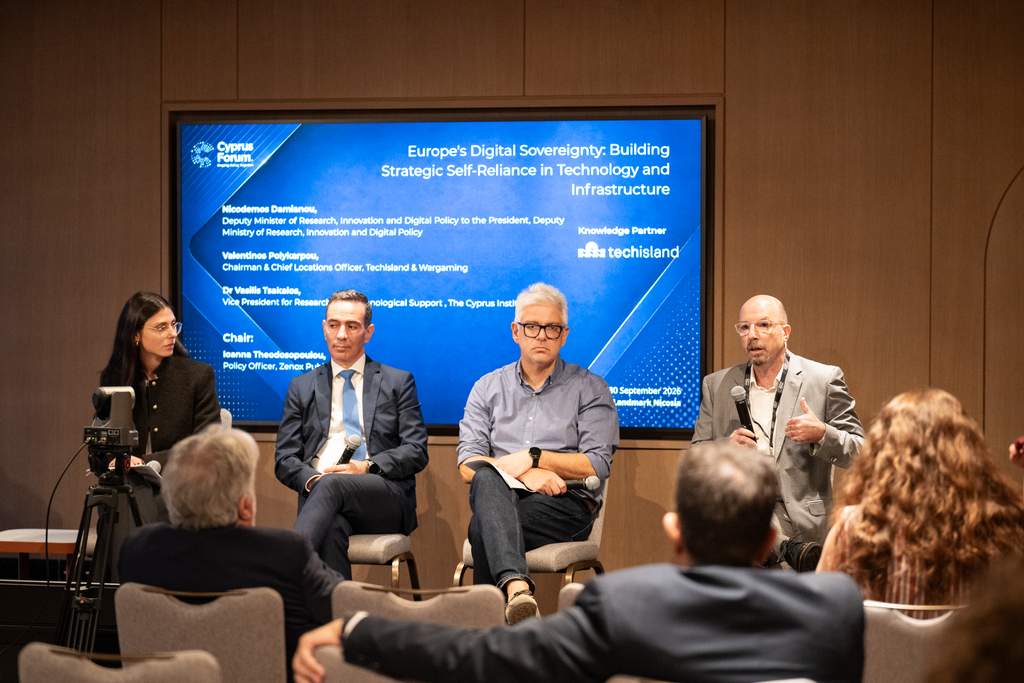
Cyprus must move beyond simply attracting technology companies and focus on getting them to develop products, intellectual property and research and development on the island, TechIsland chairman and Wargaming Chief Locations Officer Valentinos Polykarpou said at the Cyprus Forum on Tuesday.
Speaking during a panel on Europe’s digital sovereignty, Polykarpou argued that the real economic value comes not merely from companies establishing a legal or headquarters presence in Cyprus, but from relocating genuine production, R&D teams and product development.
“The real magic starts at the moment that companies are relocating real production to Cyprus,” he said, pointing to teams working locally on research, product functions and new technology.
Polykarpou said international technology companies had already brought experienced professionals and know-how from other ecosystems to Cyprus, creating knowledge that could increasingly spill over into the local workforce and startup sector.
He described the next phase in three steps: attract, retain and educate.
Attracting companies and skilled workers, he said, is only the beginning. Cyprus must then retain them and, most importantly, develop the next generation of local technology professionals.
“Attracting talent from outside Cyprus is just the very first step. It cannot last forever. We need to invest in younger generations,” he said.
Polykarpou argued that recent international upheaval had brought Cyprus something different from previous waves of capital inflows: people, expertise and technological know-how that could help deepen the country’s technology ecosystem.
Damianou: Cyprus should compete through AI adoption
Deputy Minister of Research, Innovation and Digital Policy Nicodemos Damianou said Cyprus should not attempt to compete with larger economies on technological scale.
“For us, the strategy is not to compete on scale. For us, the strategy is adoption and application of AI,” Damianou said.
He said Cyprus’ emerging AI strategy, now being finalised following public consultation, aims to position the country as a trusted EU jurisdiction where AI technologies can be developed, tested and scaled.
The strategy identifies specific sectors where AI could generate economic value, supported by two enabling pillars: education and skills, and entrepreneurship and innovation.
Damianou also highlighted the potential for AI to modernise the public sector, while stressing that new technologies cannot simply be layered onto outdated infrastructure and institutions.
“AI does not live in a vacuum,” he said, linking the country’s AI ambitions to the modernisation of existing digital infrastructure and wider government reforms.
Tsakalos: Infrastructure alone is not enough
Dr Vasilis Tsakalos, Vice President for Research and Technological Support at The Cyprus Institute, said research and computing infrastructure alone would not create a stronger technology sector.
Much of the infrastructure available to researchers and companies is already open and, in many cases, free to use, he said. The bigger problem is that many businesses either do not know how to use it or lack the expertise needed to turn a commercial or operational problem into an innovation project.
“Accessibility is just one component. The real challenge is to build an ecosystem around the infrastructures,” Tsakalos said.
That requires people capable of translating real-world business and public-sector challenges into innovation projects, as well as engineers able to implement them, he added.
Read more: