
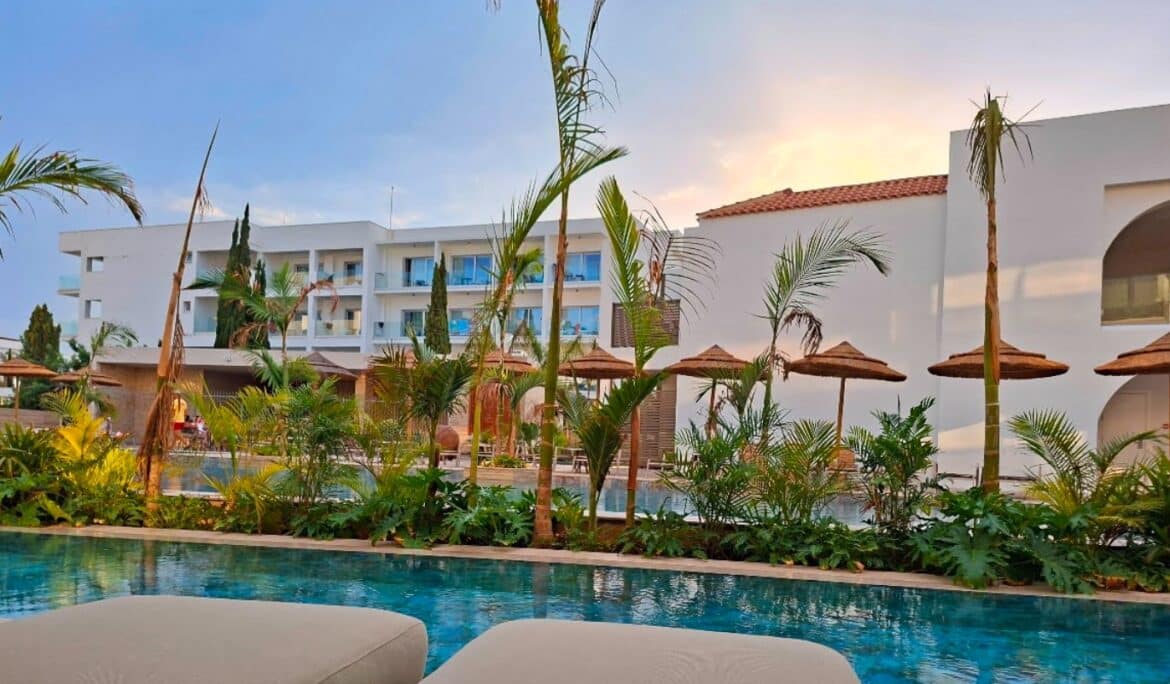
Source: cyprus-mail.com
Cyprus hotel sector relies on late autumn bookings to offset early losses
Cyprus’ hotel sector is hoping to limit its losses for 2026 to around 10 per cent, after a difficult spring was followed by more encouraging bookings in July and August, the director-general of the Cyprus Hotel Association (Pasyxe) Christos Angelides said on Wednesday.
“After the major difficulties experienced in March, April and May, with losses of around 30 per cent for the period and cancellations for the rest of the season, it appears that the efforts made by the private sector, the Deputy Ministry of Tourism and all the parties involved, such as ACTTA, Hermes and their members, have borne fruit,” Angelides told the Cyprus News Agency (CNA).
“We recovered a significant amount of the lost ground in June,” he stated, adding that July and August had performed at satisfactory levels given the large number of cancellations that had preceded them.
Angelides said the performance was particularly encouraging because 2025 had been a historic year for the hotel industry, with almost all hotels operating at full capacity.
Asked whether July and August had been stronger than the same months last year and had therefore helped reduce the year’s losses, he ruled this out, saying the comparison was with an exceptionally strong 2025.
He nevertheless described the latest information as very satisfactory and said the sector was hoping to maintain the momentum through the autumn.
“July and August were very satisfactory,” Angelides said.
The outlook for the next two months is also relatively positive, with hotel occupancy currently running at around 75 to 80 per cent for September.
“We hope for the same in October,” he said.
Angelides said last-minute bookings and reservations made only two or three weeks in advance continued to dominate the market, a pattern he said could work in Cyprus’ favour during the autumn.
Cyprus benefits from more favourable weather conditions than the Greek islands and the islands of the western Mediterranean, he said, potentially allowing the island to attract travellers later into the year.
“We hope that hostilities will remain at manageable levels for the traveller’s state of mind, so that we can achieve the numbers we are hoping for,” Angelides said.
The comments come against the backdrop of a sharp decline in Cyprus’ tourism accommodation activity during the first half of the year.
Eurostat data showed that overnight stays in hotels and other tourist accommodation in Cyprus fell by 7.7 per cent in the first six months of 2026 compared with the same period of 2025, the steepest decline recorded among EU member states.
Cyprus was one of nine EU countries to record a fall, while overnight stays across the bloc increased by 1.7 per cent to 1.321 billion during the first half of the year.
The weaker accommodation figures reflect the severe disruption suffered by the tourism sector earlier in 2026, while hotel revenue has also remained below last year’s levels despite signs of improvement.
Tourism revenue rose by just 0.2 per cent in June, reaching €423.1 million compared with €422.3 million in June 2025, while tourist arrivals fell by 1.7 per cent to 489,965.
Higher spending by visitors helped offset the decline in arrivals, with average expenditure per tourist rising by 2 per cent to €863.62 from €847.01.
However, tourism revenue for the first half of the year was estimated at €1.22 billion, down 11.4 per cent from €1.37 billion in the corresponding period of 2025.
Angelides said the modest improvement in June was not enough to compensate for the industry’s higher costs.
The increase in energy costs and inflation had been so substantial that the small rise recorded in June could not cover the increase in operating expenses, he said.
Revenue losses for the first six months therefore remained at 12.3 per cent, according to Pasyxe.
“If losses are around 10 per cent at the end of the year, the hotel industry would be satisfied,” Angelides said.
He said the sector was now waiting for final information on winter flight programmes from airlines and tour operators before it could assess the coming months more accurately.
“We need a better picture of where we are heading,” Angelides said.
He stressed that efforts to promote Cyprus as a winter destination and for 2027 must continue without any reduction in intensity.
“We have ground to make up,” he said.
Around 60 hotels remained open during the winter last year, Angelides said, describing this as a relatively small number.
“It is a small number, and we hope that gradually more hotels will remain open,” he said.
“What matters is that those that remain open stay open all year round,” he added.
Angelides said many hotels were already extending their operations into November, while some were also opening earlier in the year.
The longer-term resilience of Cyprus’ tourism market has also been highlighted in a recent international study examining how destinations recover from major crises.
A report by tourism platform TOURISE and Oxford Economics identified market diversification as one of the strongest drivers of tourism recovery, examining responses to 85 crises over the past 25 years.
Cyprus was presented as a leading example of this approach following the collapse of Russian tourism after Russia’s invasion of Ukraine and the sanctions that followed.
Russia had accounted for more than 27 per cent of Cyprus’ tourist arrivals before 2022, but its share had fallen to just 1 per cent by 2025.
Cyprus responded by shifting towards alternative European markets through targeted marketing and stronger air connectivity, with Poland’s share of arrivals rising from 2 per cent before the crisis to 9 per cent in 2025.
Angelides said Pasyxe would also introduce its Xenios Analytics statistical platform in the coming period.
The platform will provide monthly information on the performance of participating hotels and give the industry a clearer picture of current trends.
“It will give a very clear monthly picture of where our members are heading,” Angelides said.
He added that the system would provide a very objective picture of the hotel industry, potentially giving operators and policymakers a more timely basis for assessing the market.